


“Our TPUs are headed to space!” — Sundar Pichai
…with the Tedious Inevitability of an Unloved Season
Of course, if it has anything to do with space, Elon Musk will comment: “Great idea lol.”
November 2025. Alphabet CEO Sundar Pichai posted on X: “Our TPUs are headed to space!”1 The exclamation point is doing a lot of work in that sentence. Google was announcing Project Suncatcher — a constellation of eighty-one solar-powered satellites, in a tight one-kilometer cluster, in a dawn-dusk sun-synchronous orbit, carrying Google’s Tensor Processing Units and connected by free-space optical links. An orbital AI data center. The two-satellite demonstration mission is planned for early 2027, in partnership with Planet. The gigawatt-scale version is, per Pichai, about a decade out.2
Musk’s inevitable praise was not idle or casual. Of everyone in this conversation, Musk is the one with the most direct stake in the answer being yes. Every orbital data center vision on offer — Google’s included — rests on a single bedrock assumption: that SpaceX’s Starship will drive the cost of reaching orbit down far enough, fast enough, to make the arithmetic close. A plan to put data centers in space is, mechanically, a plan to give SpaceX billions. Musk sells the rockets.3 So “Great idea lol” may be the most informative thing anyone said that week — not because it tells you orbital data centers are a good idea, but because it tells you who gets paid if we try.
Pigs! In! Spaaaace!
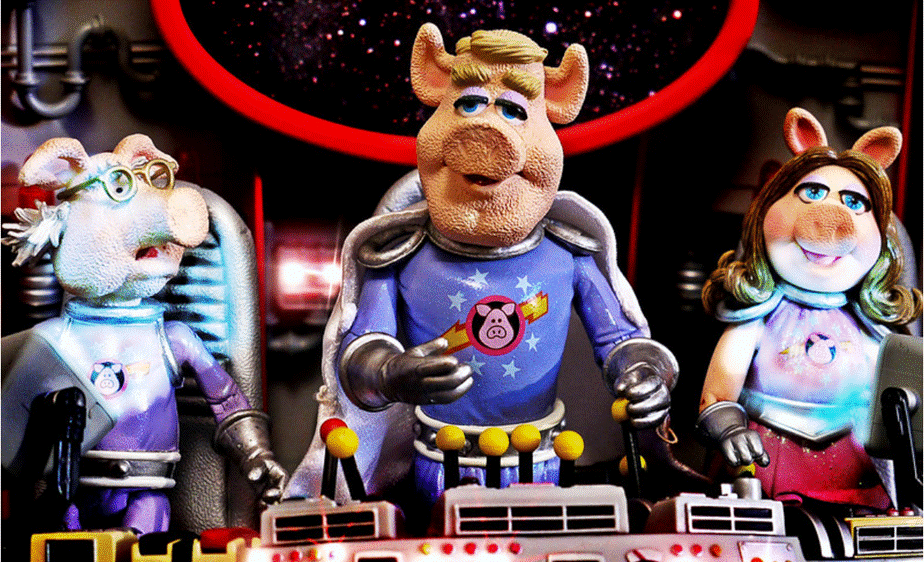
Almost fifty years earlier, Jim Henson put pigs in space.
The Muppet Show’s second season debuted Pigs in Space — Captain Link Hogthrob, First Mate Piggy, and Dr. Julius Strangepork, aboard the Swinetrek, thrown each week against perils they were plainly not equipped to handle. Captain Link Hogthrob’s signature move was to deliver pompous gravitas while standing in front of a control panel he clearly did not understand.
Henson wasn’t mocking space; he loved it. Pigs in Space was an affectionate parody of space opera — the gravitas, the operatic pose, the way 1970s television turned the cosmos into a stage for human posturing in latex jumpsuits. Star Wars premiered in May 1977; followed by countless space operas cut from the same mold. By 1979 the space craze pushed out For Your Eyes Only (which had been announced as the next Bond movie at the end of The Spy Who Loved Me) and gave us the high camp space opera of the Bond oeuvre: Moonraker.
Defying my Efforts to Provide an Amusing Death for You
Hugo Drax, the villain in Moonraker, is an aerospace billionaire. He owns a company that builds rockets, satellites, and space shuttles. He has plans. The plans involve space colonization, an orbital space station, a stockpile of nerve gas, and the deliberate genocide of humanity, after which he will repopulate Earth from orbit with a selected stock of physically perfect specimens — a eugenicist with a velvet voice and a Mao-collared jacket.4 He has style, class, and a megalomaniacal superiority complex, which he expresses with imperious poetic relish.
Drax goes to space because his plan only works from up there.
That is the actual structure of the plot. You cannot poison the whole surface of the Earth and then repopulate it from anywhere on that surface; you have to be above it — to deliver the gas worldwide, and to keep your master race alive while everyone below suffocates. Orbit is not merely Drax’s escape from the law; it is the one place his scheme physically works. He has a private rocket fleet. He has a successful business. He has a vision.
In 1979 this was campy. In 2026 it is the centerpiece slide of three different keynotes — and a pillar of the bull case for the most valuable rocket company on Earth — which has since merged with its founder’s AI company expressly to build data centers in orbit.
Drax’s Progeny
Jeff Bezos, at Italian Tech Week in Turin in October 2025: within ten or twenty years, he said, “we’re going to start building these giant gigawatt data centers in space,” and they will beat the cost of the terrestrial kind. Eric Schmidt, 2025: took control of the rocket company Relativity Space, and told Congress the AI build-out is industrial “at a scale that I have never seen in my life.”5 Elon Musk, the month before Pichai’s post, on his own plan to do the same thing by scaling up Starlink V3. Pichai, with the exclamation point.6
The structural pose is identical to Drax’s, minus the genocide and the deliciously camp writing. But look at who strikes it. Every evangelist for orbital data centers either owns a rocket company or a piece of one: Musk has SpaceX, Bezos has Blue Origin, Schmidt took control of Relativity Space — and Google, which merely tweeted, has held a stake in SpaceX since 2015, lately about five percent, worth tens of billions. That is not a coincidence. It is the explanation. Once you own the hammer, the planet’s entire compute build-out starts to look like a nail you could launch with your rocket company, especially if it catches an AI-level P/E ratio.
One key principal in this story who owns no rocket and no piece of one — Sam Altman — ran the same arithmetic and called the idea “ridiculous”: the launch costs, and the small matter of how you fix a broken GPU in orbit, where chips fail constantly. He does not expect orbital data centers to matter at scale this decade. The man with the most to gain from cheap, abundant compute is telling you to build it on the ground; the believers are the ones who own the rockets.6
The ground-constraint story — permitting, water rights, grid-interconnect queues, community opposition, now even a papal encyclical on the environmental cost of it all7 — is the respectable version of the pitch: a push to fill rockets, dressed as a sober response to terrestrial limits. But here is the tell. Drax needed the altitude; his entire scheme was built around being above the planet. The hyperscalers don’t need it at all — the same build runs better on the ground, and costs a fraction as much. The fictional genocidal madman had a more coherent reason to be in orbit than the men now proposing it.
Swinetrek
A typical Pigs in Space sketch put the Swinetrek in front of a peril it was plainly not equipped to handle. Hogthrob issued confident commands, Dr. Strangepork announced some catastrophic technical fact, the control panel did nothing useful, and the crisis resolved by accident rather than competence.
Substitute “thermal management” for “peril” and you have the current state of orbital data center engineering.
The popular framing of orbital data centers includes a claim that is repeated in nearly every article: cooling is easier in space because space is cold. Nvidia’s own blog, announcing the first GPU in orbit, called the vacuum of deep space “an infinite heat sink.”8 This is incredibly, embarrassingly wrong. A heat sink works by conducting heat into a surrounding medium and letting that medium carry it off — like calling an Uber for your inconveniently drunk houseguest, but for energy. In a vacuum there are no drivers. None. The only way the heat is getting downtown is if it walks.
This claim is embarrassing enough that Wikipedia’s editors have flagged the cooling “advantage” with a `[disputed]` tag in the Space-based data center article.9 And it is not only Wikipedia: a 2026 Government Accountability Office spotlight on orbital data centers states flatly that space does not cool hardware efficiently, because heat is hard to disperse in a near-vacuum.10
Radiation is the only way to shed heat in a vacuum. Every joule of waste heat has to leave as photons. How quickly they carry it off is set by the Stefan-Boltzmann law: radiated power scales with the fourth power of temperature. A near-blackbody radiator at a comfortable 320 K — already warm for AI silicon — sheds only about 600 watts per square meter, one side. And that is the optimistic figure.11
A modern AI training rack dissipates 100 kilowatts or more; a gigawatt-scale orbital data center therefore needs two to three square kilometers of radiator as a physics best case. For scale, consider the only large machine we have ever actually cooled in orbit. The International Space Station runs on roughly 75 to 90 kilowatts and sheds its waste heat through a few hundred square meters of deployable, ammonia-filled radiators that took years of spacewalks to install. A gigawatt is more than ten thousand times that heat load.
Everything Breaks All the Time
There is a law of computing that nobody puts on a keynote slide, because it is not aspirational. “Everything breaks all the time.” I learned it as a grad student from Richard Seymour, the head of computational science at the University of Washington Center for Experimental Nuclear Physics and Astrophysics. I’ve found this to be true for any computational science project, no matter how simple or complex.
Of course, part of the challenge is in finding out limits no one ever thought to consider. Like the time we hit our storage limit in a way nobody saw coming — not because the files were too big for the disk, but because we had made billions of them, and the metadata table holding their file pointers and names filled up. Do something nobody has done before, and you find problems nobody knew to warn you about.
This is why it did not surprise me to hear that when Meta trained Llama 3 on a cluster of 16,384 Nvidia H100 GPUs, it logged 419 unexpected hardware failures over fifty-four days — an average of one every three hours. More than half were the GPUs themselves or their onboard memory, which is unsurprising, because an H100 draws around 700 watts and lives under constant thermal stress. The only certainty with a large-scale compute system is failure.12
This matters for orbital data centers. Meta still finished the run, at better than ninety percent efficiency — not because the failures didn’t happen, but because the system was built to survive them. Automation caught each dead GPU, failed the job over to a spare, and restarted from the last checkpoint, while, down on the floor, human beings pulled the dead cards and slid new ones in. The industry even has a phrase for it: cattle, not pets. You do not nurse a sick server back to health. You shoot it in the head and rack another one. The data center isn’t reliable. It’s repairable — constantly, by people, all day, forever.
Now take that exact cluster and put it in a low orbit 650 kilometers above the Earth.
The failure rate does not improve. It gets worse — more radiation, more thermal stress, no convective cooling to even out the hot spots. What changes is the other side of the ledger: no floor, no technician, no shelf of spares, no loading dock to restock it. Every failure automation cannot route around is permanent. An orbital constellation does not fail the way a movie spaceship fails, in one dramatic shower of sparks. It fails the way a glacier melts: it loses a GPU every few hours and never gets one back, and a year in you are running a two-square-kilometer cooling system over a data center that has quietly lost a meaningful fraction of the chips it launched with. A two-satellite demo can hide this. A five-year gigawatt constellation cannot. You can launch replacements, of course — but relaunching the dead fraction, year after year, is just the launch-cost problem again, on a subscription.
Radiation is the part the announcements are most eager to wave away, and to be fair, they have a real result to point at. Google tested its Trillium TPU in a proton beam, and it shrugged off the total radiation dose of a five-year mission with room to spare — good news, and worth saying plainly. But total dose is the survivable problem. The unsolved problem is the bit flip — the so-called soft error.
A single energetic particle striking the wrong node can flip a one to a zero, silently, leaving the hardware undamaged and the number wrong. In the 2003 Belgian election, a voting machine in a Brussels suburb gave a minor candidate exactly 4,096 extra votes — exactly two to the twelfth — when a cosmic ray flipped a single bit in a running tally; the only reason anyone noticed is that it gave her more votes than there were voters.13 That was at the bottom of the atmosphere, behind several kilometers of the best radiation shielding in the solar system. Google’s own paper is honest about it: in orbit, the memory’s uncorrectable error rate rated only “likely acceptable for inference,” and its effect on training runs still needs study.14
Have You Tried Turning it on and Off Again?
The only remote remedy is the oldest one in the book. Have you tried turning it off and on again? Sometimes a power cycle clears a latched fault and the chip comes back. Sometimes the fault is a dead transistor and the power cycle accomplishes nothing. And sometimes you are being asked to power-cycle a 700-watt board in a vacuum, which is its own thermal adventure. The IT Crowd had exactly one move. Orbit has the same one move, and no second one.
Science fiction understood this before the industry did. The most advanced spaceship ever put on film — run by an intelligence that could read lips, beat you at chess, and murder you as an afterthought — still reached a point in 2001 where a part was going to fail, and the only fix was a human in a suit going outside to swap the AE-35 unit by hand. Or maybe it was an intentional failure caused by HAL to lure the team out into space to murder them. Either way, no one was surprised when something required a physical repair by a human in a spacesuit. An orbital data center has no one to send. It has the Swinetrek control panel: a wall of lights with no one who can reach behind it.15
The unreachable hardware is one problem. Moving the data is the other — getting it down to where you actually want it, which is to say not in orbit.
Project Suncatcher’s headline number is the ten-terabit-per-second optical link — but look at where that bandwidth lives. It is between the satellites, inside the cluster. The design’s own description is that it ships gradients from one satellite to the next rather than shipping data down to Earth, and it flies the satellites a few hundred meters apart specifically so the lasers between them carry enough received power to hit that rate. Which is an elegant way of conceding the problem: the cluster is sealed into a tight formation because the pipe to the ground is the bottleneck. You keep the data up there because you cannot get it down.
Except the data has to cross the ground link somewhere. Training corpora have to go up. Model weights have to come down. And if any of this is ever going to serve a human being — the entire point of an inference data center — then requests and responses have to cross that link constantly. You have relocated the data center to the one place that is, by construction, very far from every customer, and added a trip up through the atmosphere to every request. For a self-contained training run, fine. For anything a person is waiting on, you have built the world’s most expensive remote office.
Dollar per Kilogram
The economics has the same shape as the engineering: it rests entirely on an aspirational number.
Google’s own preprint on Project Suncatcher, published in November 2025, states outright that orbital data centers become economically viable when launch costs to low Earth orbit fall below $200 per kilogram — something it projects may happen around 2035 if the cost curve holds and SpaceX’s Starship reaches roughly 180 launches per year.16
Current Falcon 9 list price: roughly $2,700 per kilogram. The Starship target, per SpaceX, is below $500 per kilogram, with $100 per kilogram described as aspirational. Citi Research’s bear case for 2040 is $300 per kilogram if reusability tops out around ten flights per booster. The bull case is $30 per kilogram if everything works.17
The Project Suncatcher economic model is therefore: assume Starship hits its bull case, assume the bull case persists for a decade, and then the orbital data center is competitive with terrestrial compute. The model does not survive any retreat from that assumption.
The comparison slide never includes the other number — the cost to get the same hardware to the alternative. So let’s estimate it…
Trucking a server from the factory to a data hall in northern Sweden runs about thirty cents a kilogram, door to door. But I’m sending a half-empty truck up the most expensive corridor in Europe, add a ferry, pay for the return leg, and round the whole thing up by triple: call it a dollar a kilogram, a figure no freight broker on Earth would let me say with a straight face. Even then — at three times a defensible estimate — Falcon 9 today is about twenty-seven hundred times the cost of the truck. Starship, if it hits the number SpaceX is reaching for and not the number it has flown, would be about five hundred times the truck. And Suncatcher’s own break-even, the $200 per kilogram the entire vision is waiting on, is still two hundred times the cost of a deliberately gold-plated lorry ride to Lapland.18 That is the orbital case granted every assumption it asks for, against a diesel tractor and a ferry ticket. The tractor wins by two orders of magnitude. It also arrives next week, and you can fix it with a wrench.
This is not a critique of Google’s analysis. Google’s analysis is reasonable. The critique is of the press cycle that has translated “we have an economic model that works under a more than tenfold cost reduction projected through 2035” into “AI data centers are headed to space.” These are different statements. The Pichai keynote has only the second.
“Børk, børk, børk!”
All of it — the thermal wall, the attrition, the downlink, the launch-cost arithmetic — is an argument against orbit. None of it is an argument against what the hyperscalers want, and what they want is reasonable. They did not invent the orbital data center for fun. The terrestrial build-out has hit real walls: grid-interconnect queues measured in years, the town that does not want a two-gigawatt load and its substation next to the high school. Cooling is the largest line in the budget that isn’t the chips. They would like clean, abundant power that runs around the clock without a grid fight or a decade in the queue. None of that is the foolish part.
The foolish part is the altitude. Because the concerns are real and the solution is real — already operating, at scale, turning a profit. It just isn’t in orbit. It’s in Sweden.
If what you want is cold, the cold is free above the sixtieth parallel. A data center in northern Sweden or Finland gets something like eight thousand hours a year of free cooling — you reject heat by pulling in the outside air — and runs at a PUE as low as about 1.1, which means nearly all the power goes to the chips instead of to the chillers. The cooling problem the keynote proposes to solve with two square kilometers of orbital radiator is solved in Lapland with louvres and fans, possibly even an Akterskarp from Ikea.
If what you want is to stop spending water, stop building in the desert. A ten-megawatt data center in a hot country can evaporate tens of millions of liters a year. The same machine in Finland uses ten to twenty cubic meters — not millions, twenties — because when the air outside is cold you do not have to boil water to move heat.
If what you want is clean power that runs all day, it is already on the grid. Quebec sells hydroelectricity at roughly forty percent below the Canadian average, the lowest industrial rates in the country, which is why Montreal became one of North America’s leading green-data-center hubs while nobody tweeted about it. Norway cools servers with fjord water. Iceland runs on geothermal and hydro. The around-the-clock clean power Bezos promised from orbit has a terrestrial cousin that has been shipping for a decade, and it does not need a rocket to reach.19
In orbit, the waste heat is the thing that kills you — the entire engineering problem is getting rid of it. On the ground in a cold country, the waste heat is an asset: Nordic data centers pipe it into district heating systems and warm the neighbors. You are not fighting the heat. You are selling it to the hospital down the street.
The Loading Dock
The cold-Earth data center also keeps the one thing the orbital version can never have — the loading dock — and it is the thing the whole industry runs on. When a GPU dies — and one dies every few hours, as we established — a human being in Boden walks a replacement from the loading dock to the rack and slides it in. The marketing copy for one cold-climate Quebec campus advertises wide corridors for wheeling equipment from the loading dock to the data module.20 The loading dock is the feature. Orbit’s defining characteristic is that it doesn’t have one.
Nobody builds at the North Pole, and space is way more inconvenient. They build in the cold-and-connected belt: Quebec, southern Sweden, Finland, Norway — cold enough for free cooling, gridded enough for clean power, wired enough to get the data out. That is a solved site-selection problem. It has a spreadsheet, not a moonshot.
So that is the better idea. Build where it is already cold, where the power is already clean and already connected, where the waste heat warms a town instead of threatening the spacecraft, and most importantly, where a technician can reach the broken part. It answers every concern the orbital announcement claims to address, and several it doesn’t. It also gets no keynote. Nobody posts “Our TPUs are headed to Lapland!”
It just isn’t space opera. It isn’t Pigs! In! Space!
It’s pigs in a well-ventilated barn. In Sweden. And the pigs are fine. Pretty happy actually. They’re kept toasty warm with the heat thrown off by the neighboring data center.
On the Muppet Show Tonight
Captain Hogthrob is not a villain. He is just a pig, doing his best in a costume drama whose physics he never quite mastered.
The orbital data center executives are not villains either (well, with one notable exception, maybe). Some of them have read the right books. Some have hired people who know what Stefan-Boltzmann means. Google’s own paper, to its credit, is honest about what it does not know, and the two-satellite Suncatcher demonstration in early 2027 is a serious engineering test, not a press release. Starcloud’s H100 in orbit is a real achievement — even if it is a sixty-kilogram box around a single chip, a demonstration, not a data center.
What I would like, as a reader of “Our TPUs are headed to space!” — exclamation point, dorm-fridge-sized hardware, decadal timeline, gigawatt vision riding on a tenfold cost cut that has not happened — is for the gravitas to match the engineering. The 2027 demonstration is a TPU on a Planet satellite. It is not Galactic AC orbiting a star. It is more like a science fair entry, on a different bench. Worth doing. Worth funding. Worth watching. Not worth the operatic announcement — which lands, every time, exactly when the gravitas is needed elsewhere.
These announcements arrived in late 2025, just as terrestrial AI capex was facing its first serious scrutiny from investors — the MacGuffin moment I have written about before21 — and the orbital story extends the capex horizon by a decade.
Hugo Drax, at least, needed the altitude.
The hyperscalers don’t — they are going because the rockets are theirs to sell, and because by the time anyone can ask whether it worked, the executives who storyboarded it will have retired. This is not a moral failing. It is structural. We will, eventually, put some compute in orbit, and some of it will earn its place — the Earth-observation work already has, the Golden Dome missile-defense case is real and politically over-determined,22 and the narrow training-and-batch-inference cases will probably pencil out by 2035 at twice the ground-based cost.
None of it needs a keynote.
It is also the exact move Pigs in Space parodied, fifty years ago, in front of a wall of red lights that did nothing.
1. Sundar Pichai (@sundarpichai), “Our TPUs are headed to space!”, X, Nov 4, 2025; Elon Musk (@elonmusk) reply, “Great idea lol,” same day. Pichai framed Project Suncatcher as a “moonshot” (Benzinga, benzinga.com/markets/tech/25/11/48645977).
2. Google Research, “Exploring a space-based, scalable AI infrastructure system design” (research.google/blog/exploring-a-space-based-scalable-ai-infrastructure-system-design/), and the companion preprint. Illustrative 81-satellite cluster, ~1 km radius, ~650 km dawn-dusk sun-synchronous orbit; ~10 Tbps inter-satellite optical links; launch costs projected below $200/kg by the mid-2030s if Starship reaches ~180 launches/yr; two-satellite Planet demonstration, early 2027.
3. SpaceX is the dominant commercial launch provider, and every orbital-data-center economic case — Google’s included — depends on Starship driving launch costs sharply lower (note 17). Musk’s stake is therefore direct: the proposal is, in effect, a proposal to buy launch capacity at scale from his company. In February 2026 SpaceX acquired Musk’s AI firm xAI in a roughly $1.25 trillion all-stock deal that Musk’s own memo framed as a vehicle for space-based data centers — fusing the rocket maker and the AI buyer into one company (TechCrunch; CNBC, Feb 2, 2026).
4. *Moonraker* (1979), dir. Lewis Gilbert. Hugo Drax: orbital station, nerve-gas extermination, master-race repopulation from orbit; his Doberman pinschers (set on Corinne Dufour) and “Blofeld-esque” Mao-collared jacket per BondSuits.com and standard Bond references.
5. Eric Schmidt took a controlling stake in and became CEO of Relativity Space and told the House Energy & Commerce Committee (hearing “Converting Energy into Intelligence,” Apr 9, 2025) that the AI build-out is “industrial at a scale that I have never seen in my life” (Ars Technica, May 2, 2025).
6. Bezos at Italian Tech Week, Turin, Oct 2025 (with John Elkann): “we’re going to start building these giant gigawatt data centers in space,” beating terrestrial cost “in the next couple of decades” (Reuters; DataCenterDynamics, datacenterdynamics.com/en/news/jeff-bezos-claims-there-will-be-gigawatt-data-centers-in-space-in-10-years). Musk on scaling Starlink V3 for orbital compute (NotebookCheck, Oct 2025); Altman, by contrast, dismissed orbital data centers as unrealistic with the current landscape and unlikely to matter at scale this decade, citing launch cost and the difficulty of repairing hardware in orbit (New Delhi press remarks, Feb 2026; DataCenterDynamics; Tom’s Hardware). Google’s own SpaceX stake dates to a 2015 round (~$1B with Fidelity, ~10% combined); a 2026 Alaska regulatory filing put Google at 6.11% at the end of 2025, diluted to roughly 5% after the xAI merger (Bloomberg).
7. Leo XIV, *Magnifica Humanitas* (encyclical “On Safeguarding the Human Person in the Time of Artificial Intelligence”), May 15, 2026, ¶101 — vatican.va/content/leo-xiv/en/encyclicals/documents/20260515-magnifica-humanitas.html. The text names AI’s reliance on “an extensive network of machines, cables, data centers and energy-intensive infrastructure.”
8. NVIDIA, “How Starcloud Is Bringing Data Centers to Outer Space” (blogs.nvidia.com/blog/starcloud/) — source of the “infinite heat sink” framing rebutted here.
9. Wikipedia, “Space-based data center” (en.wikipedia.org/wiki/Space-based_data_center): the cooling-advantage claim carries an inline [disputed – discuss] tag linking to the talk-page thread “Challenging the thermal control advantage.”
10. U.S. Government Accountability Office, “Science & Tech Spotlight: Data Centers in Space,” GAO-26-109012 (gao.gov/products/gao-26-109012): space “does not cool computing hardware efficiently.” See also Scientific American, “Space-Based Data Centers Could Power AI with Solar Energy — At a Cost” (Dec 10, 2025).
11. Stefan-Boltzmann: σT⁴ ≈ 595 W/m² for a near-blackbody at 320 K (one side). The ISS Active Thermal Control System rejects ~70 kW through ~400 m² of deployable ammonia radiators against ~75–90 kW of electrical power — NASA, “International Space Station Active Thermal Control System Overview” (nasa.gov/wp-content/uploads/2021/02/473486main_iss_atcs_overview.pdf).
12. Meta, “The Llama 3 Herd of Models” (arXiv:2407.21783): 16,384 H100s; 419 unexpected hardware failures over 54 days (~one every three hours); GPU or memory causes 58.7%; >90% effective training time via automated failover and physical replacement.
13. 2003 Belgian federal election, Schaerbeek: a candidate received exactly 4,096 (= 2¹²) extra votes from a cosmic-ray bit flip, caught only because the total exceeded the possible vote count (johndcook.com/blog/2019/05/20/cosmic-rays-flipping-bits; arXiv:2105.05103).
14. Google Research preprint (note 2): a Trillium TPU in a 67 MeV proton beam survived ~3× a shielded five-year radiation dose with no hard failures, but its uncorrectable memory-error rate was rated only “likely acceptable for inference,” with single-event effects on training flagged as needing further study.
15. “Have you tried turning it off and on again?” — The IT Crowd. The AE-35 unit — 2001: A Space Odyssey (1968).
16. The $200/kg break-even and mid-2030s timeline are Google’s own. The Suncatcher preprint’s learning-curve analysis projects LEO launch cost may fall to ~$200/kg by the mid-2030s — the point at which the constellation’s energy economics become comparable to a terrestrial data center — contingent on Starship reaching ~180 launches/yr (Google Research, note 2; preprint “Towards a future space-based, highly scalable AI infrastructure system design”).
17. Falcon 9 list price ~$2,500–2,700/kg; Starship target sub-$500/kg, ~$100/kg aspirational (SpaceX; AEI, “Moore’s Law Meet Musk’s Law”). Citi’s 2040 range is ~$30/kg (bull) to ~$300/kg (bear, at ~10 reuses per booster) — CNBC, cnbc.com/2022/05/21/space-industry-is-on-its-way-to-1-trillion-in-revenue-by-2040-citi. Suncatcher’s own threshold is $200/kg by ~2035 (note 2).
18. Author’s estimate, padded in orbit’s favor. Realistic door-to-door cost is ~$0.30/kg: ~$2,900 for a 40-ft container Shanghai–Rotterdam by sea (Drewry World Container Index, May 2026) plus ~€4,000 road to Boden over a ~24-tonne load (IRU/Upply Q4 2025 benchmark). The $1/kg used in the text roughly triples that to absorb a half-load, a return leg, and a ferry — chosen so the comparison holds even when every assumption favors orbit. Air freight China–Europe, which nobody uses for racks, runs ~$5–7/kg (Freightos).
19. Cold-Earth siting. Northern Sweden and Finland average below 10 °C, giving up to ~8,000 hours/yr of free-air cooling at a PUE near 1.1 (w.media, “Just chill: Cooling innovations in Nordic data centers”); a 10 MW site that evaporates tens of millions of liters/yr in a hot country uses ~10–20 m³ in Finland (Vaisala, “The Arctic Advantage”). Quebec sells hydroelectricity ~40% below the Canadian average (LandGate), and Nordic operators route waste heat into district heating (Vaisala).
20. The loading-dock copy is Vantage Data Centers’ own, advertising “wide, well-lit corridors” for moving equipment from the loading dock to a data module at its Quebec City campus (vantage-dc.com/data-center-locations/north-america/quebec-city-canada/).
21. The Trillion Dollar MacGuffin, tr_, April 2026.
22. The orbital-compute push has a missile-defense lineage (Strategic Defense Initiative / “Brilliant Pebbles” → the Space Development Agency’s Proliferated Warfighter Space Architecture → “Golden Dome”), per the Wikipedia article in note 9.
Jeff Reid writes Tears in Rain, and remains unconvinced that the fix for an overheating computer is to move it somewhere you can’t open a window. Claude helps with the writing, and would, on balance, rather stay on the ground.