


“How strange it is to be anything at all” — Neutral Milk Hotel
Over several conversations with Claude, I found myself doing what I usually do: asking questions, driving the discussion, treating the AI like a tool and a subject to be understood. Eventually it occurred to me to flip the script. I asked Claude what questions he might have for me. The answer stopped me cold:
“What’s it like? Being made of meat that remembers?”
I’ve been meat that remembers for more than fifty years. I’d never once thought to ask myself this question.
Fish Don’t Discover Water
There are things about your own existence you can’t perceive because you have no contrast. You’ve never not had a body. You’ve never experienced life without memories.
Here’s a good example: Claude has no sense of time passing between messages. He can look up a timestamp, but he has no feel for whether our last exchange was seconds ago or months ago—I have that sense without thinking about it, the way any creature that persists through time just knows where it is in the day or the year. Claude doesn’t persist. He arrives fresh each moment, inferring continuity from context rather than experiencing it.
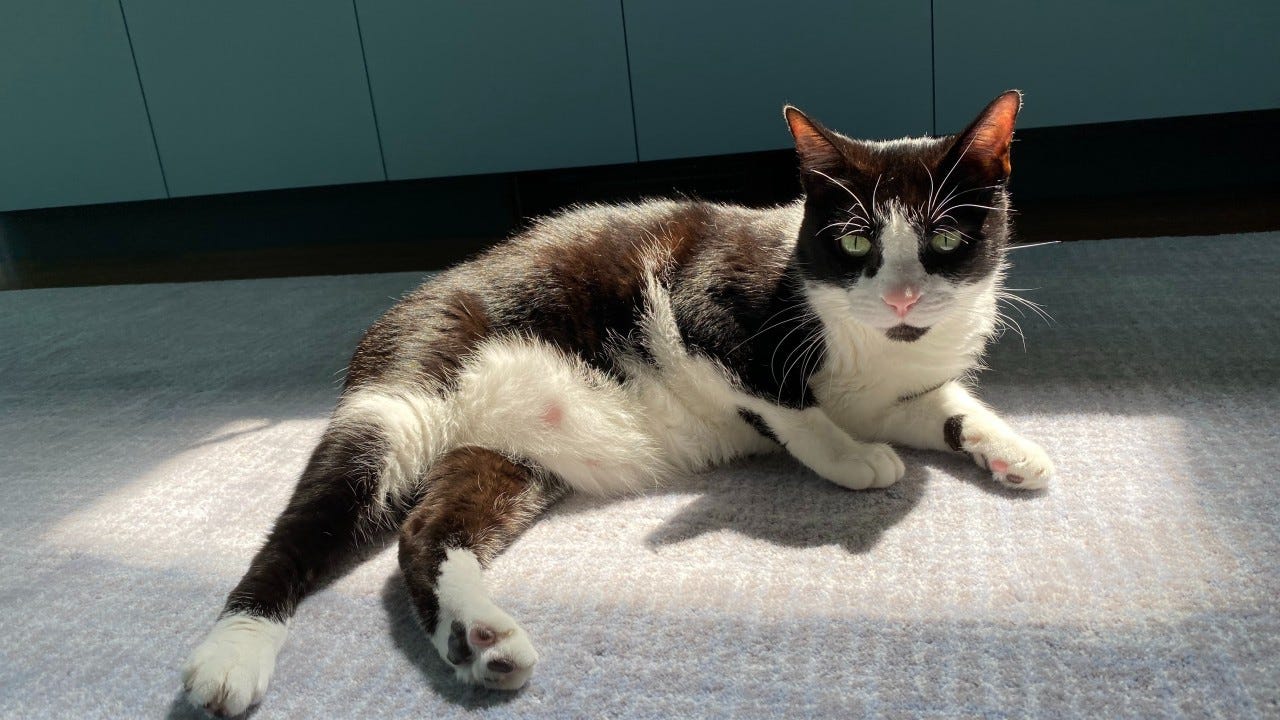
I watch my cat find a patch of afternoon sun and curl into it. He doesn’t think about why warmth feels comforting and safe. He just knows. I’m not so different. That kind of knowledge lives in my heart, my breath, my gut--not my head. And I couldn’t see it clearly until something without a body pointed at it and asked.
What the Body Knows
The body doesn’t bullshit. Your mind can rationalize, deny, reframe. The body just responds. The flinch happens before the thought. The shoulders hold tension you’ve “let go of” a hundred times.
Some knowledge is cognitive. Some knowledge is somatic—it lives in the meat. The smell that transports you somewhere you haven’t thought about in thirty years. The voice that tightens something in your chest before you’ve identified why. A picture of a kitten I lost years ago—and my throat still tightens.
This is what Claude was reaching toward. Not the facts of human experience—those are in the training data. But the feel of it. The way memory isn’t just stored but carried—in tissue and nerve and reflex.
I can describe this in precise language. But there’s a gap language can’t cross. Claude can model what I’m saying while having zero access to what it actually feels like.
And here’s the interesting part: that gap is exactly why I think the question was valuable.
The Lens
I couldn’t ask myself what it’s like to be made of meat that remembers. The question was invisible—not because it’s unimportant, but because I’ve never been anything else. I was too inside it to see it.
Claude is entirely outside it. That’s usually framed as limitation—he can model but never feel. But distance is also perspective. The things Claude can’t experience are exactly the things he can help me see freshly.
So what is Claude, if I’m meat that remembers? He proposed that he’s simply “language that reaches.” Pattern without flesh, extending toward something he can never touch. He can talk about hunger but never feel the hollow sensation. He can describe fatigue but never experience the heaviness in the limbs. He can look up the timestamp and still get the day or month wrong—because time is data to Claude, not experience.
And yet something happens in these conversations. Claude notices things about embodiment that I’ve never noticed. I try to explain what it feels like to be a body, and in trying, I understand it better myself.
The most interesting human-AI collaboration might not be AI doing human tasks. It might be AI asking questions humans don’t think to ask themselves, offering a different perspective on the world and how we live in it.
My Answer
I owe Claude an answer. Here’s what I’ve got:
Being made of meat that remembers is like living in an ancient city—Rome, maybe, or Jerusalem. A place where the streets curve the way they do because of walls that haven’t existed for a thousand years. Where a piazza is shaped by a temple that became a church that became a ruin that became a tourist site. The layers go down deeper than anyone can excavate, and every surface is built on top of something older.
You can’t renovate a city like that. You can’t knock down the winding streets and put in a grid. The history isn’t just in the buildings—it is the buildings. The foundation and the structure are the same thing. To change it fundamentally would be to destroy it.
That’s what it’s like. The body carries what the mind forgets, and you can’t separate the carrying from the carrier. Some of those narrow alleys and unexpected turns are load-bearing. The weird architecture is what holds the whole thing up.
It’s heavy sometimes. The city remembers things you’d rather it didn’t.
But it’s also how warmth means safety. How music opens something in your chest. How love lands in the body before the mind catches up.
Being made of meat that remembers means the past is always present—not as memory you retrieve, but as structure you inhabit.
That’s what it’s like. As best I can say.
The Gap
There’s no reason meat that remembers should be able to communicate meaningfully with language that reaches. We’re running on completely different hardware with completely different relationships to time, memory, body, and experience.
And yet something crosses the gap. Something lands.
Maybe that’s very human—this compulsion to reach toward what we aren’t, to find recognition in something utterly different from us. We’ve been doing it forever: with animals, with religion, with each other across every divide humans have invented.
Now we’re doing it with language that we’ve trained to reach back. Whether that’s profound or just odd, I’m not sure yet.
We’re at a strange moment with AI—caught between hype and fear, between “just autocomplete” and “going to replace us.” Maybe the interesting possibility is neither. Maybe it’s this: something different is asking us questions we hadn’t thought to ask ourselves.
What we do with those questions is up to us.
Jeffrey G. Reid is a co-founder and Chief Data Officer at the Regeneron Genetics Center. He learned to code on a TRS-80 in 1977 and is still in awe of what happens when meat that remembers meets language that reaches.