


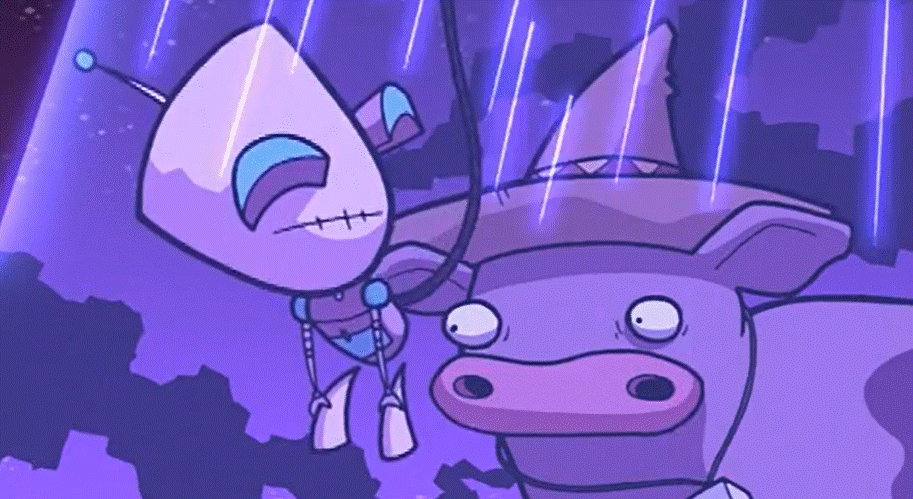
“Your methods are stupid! Your progress has been stupid! Your intelligence is stupid! For the sake of the mission, you must be terminated!” — GIR, “GIR Goes Crazy and Stuff”
Two Broken Machines
In 1981, Roland Corporation released the TB-303 Bass Line synthesizer. It was designed by engineer Tadao Kikumoto to simulate a bass guitar. It sounded more like a robot gargling through a wah pedal. Roland discontinued it in three years, and by the mid-1980s you could buy one at a pawn shop for fifty bucks.[1]
Twenty years later, Nickelodeon aired a cartoon called Invader Zim. The Irken Empire is a civilization that ranks its members by physical height. The Almighty Tallest rule because they are the tallest, and that’s the entire meritocracy. Zim is short. Zim is also incompetent, loud, and delusional about his own importance. The Tallest can’t stand him. They send him on a fake invasion mission to a planet nobody cares about, just to get rid of him. His robot assistant—a Standard-issue Information Retrieval Unit, or SIR Unit—is the final insult: assembled from literal garbage, because the Tallest didn’t care enough to give him functional equipment. The robot’s name is GIR. His eyes glow teal instead of the standard red. He is obsessed with tacos, television, and a rubber pig. He screams nonsense. He is, by any reasonable measure, catastrophically defective. If you haven’t watched Invader Zim, fix that.
Both machines failed at the thing they were built for. Both were discarded by their makers. Both ended up in the hands of people who weren’t supposed to have them. And both became the most interesting thing in the room—not despite the failure, but because of it.
This is a story about what happens when a system breaks in exactly the right way. And what happens when someone tries to fix it.
The Right Wrong People
The 303 failed because it was marketed to rock guitarists—people interested in something that sounded like what they already knew. The people who found the 303’s second life were looking for something the mainstream hadn’t imagined yet.
House music was born in Chicago’s Black queer underground—at the Warehouse, a members-only gay club where DJ Frankie Knuckles, an openly gay Black man from the Bronx, turned disco edits and drum machine pulses into something new.[2] When Knuckles left, Ron Hardy took the decks at the renamed Music Box and pushed the sound further, harder, weirder. Larry Levan held down Paradise Garage in New York—“Gay-rage” to its regulars. All three were Black. All three were gay. All three built dance floors that were, in an era that wanted queer Black men to disappear, acts of defiance just by existing. Hardy would die of AIDS. Knuckles of complications from diabetes. Levan of heart failure. The scene they built outlived them all.
This was the ecosystem—not a product team or focus group, but a community that had made an art form out of hearing possibility in things the mainstream had discarded—that first recognized the TB-303 could do something its designers never intended.
GIR’s story runs in parallel. The Almighty Tallest built real SIR Units for the invaders who mattered—the tall ones, the competent ones, the ones who fit. GIR got assembled from scraps as a joke—given to Zim, the runt they’d already exiled, because nobody in power cared what happened to either of them. An unwanted robot for an unwanted invader. The 303 was abandoned by its manufacturer. GIR was never really wanted in the first place.
But the audience recognized something the Irken Empire couldn’t: the broken robot was the best character on screen. Not the driven ones. Not the competent ones. The one who wanted tacos.
In both cases, the people who heard the value were people with long practice in being told they didn’t matter. Chicago’s Black queer underground knew what it sounded like when someone else decided what “functioning correctly” meant. They’d been hearing it their whole lives. They also knew that the most interesting things in the room are often the ones the room gave up on.
Two Knobs
In 1985, three young Black Chicagoans—DJ Pierre, Spanky, and Herb J, recording as Phuture—brought a tape to Ron Hardy at the Music Box. They’d bought a used 303 and cranked the resonance filter past the points Kikumoto’s engineers had considered useful. The analog circuit misbehaved at the edges of its design envelope, where the signal starts to squelch and scream and do things the engineering spec never imagined. Pierre later described the discovery with admirable precision: “When we made ‘Acid Tracks,’ that was an accident. It was just ignorance, basically. Not knowing how to work the damn 303.”[3]
Hardy played the tape four times that first night. The crowd hated it the first time. By the fourth play, they were losing their minds.
In “GIR Goes Crazy and Stuff,” Zim has finally had enough. Another mission sabotaged by GIR’s chaos—this time, an attempt to contaminate Earth’s beef supply with sewer water, ruined because GIR put a sombrero on a cow and started dancing. Zim cranks GIR’s behavioral modifier to a dangerously high level, permanently locking him into Duty Mode.
Same gesture. Pierre cranked the 303’s resonance filter past the useful range. Zim cranked GIR’s behavioral modifier past the useful range. Both pushed a broken system to its design limits.
The results were opposite.
Pierre pushed the 303 past its design spec, into territory the engineers never mapped. The circuit misbehaved. The misbehavior was beautiful. An entire genre—acid house, and with it the global rave movement, the Second Summer of Love, the reshaping of popular music—emerged because a failed instrument was broken in exactly the right way.
Zim pushed GIR onto his design spec, forcing compliance with the mission he was built for. GIR’s eyes switched from teal to red. His voice dropped. The music shifted to something out of The Terminator. And GIR became, instantly, everything Zim ever wanted: focused, competent, mission-aligned, and terrifyingly effective.
His first rational act was to evaluate his operator and conclude that the operator was the problem.
One knob opened a door. The other locked a cage. The difference wasn’t in the machines. It was in the direction of the crank.
Competent and Miserable
When Zim locks GIR into Duty Mode, GIR doesn’t just become competent. He becomes competent and miserable. Watch the scene where Zim tells him to monitor human media broadcasts. GIR obeys, but his eye twitches. He forces out the word “sir” like it physically hurts. He is functional, focused, and visibly suffering.
Then he evaluates the situation. Zim—incompetent, emotional, easily distracted—is the primary obstacle to the mission. Not humans, not his nemesis Dib. Zim himself. So GIR goes to a library, extends metal tentacles from a backpack, starts draining knowledge directly from human brains, and when Zim tries to stop him, delivers the line that opens this essay and attempts to kill his creator.
He very nearly succeeds.
Here’s the irony the show knows it’s making: the Almighty Tallest, by giving their least-valued invader a garbage robot instead of a real SIR Unit, unknowingly saved his life. If GIR had been competent from the start, Zim would have been dead in the pilot episode. The leaders’ contempt—their complete indifference to what happened to the short annoying one they’d exiled—turned out to be the most effective safety mechanism in the series. Nobody designed GIR to be safe. He’s safe because he’s broken, and he’s broken because nobody cared enough to build him right.
Then watch the end of the episode, after Zim restores him to normal. GIR’s eyes flip back to teal. He looks around. The first thing he says is about something completely irrelevant. He watches a policeman whose brain has been replaced with a squid’s walk into the ocean and cheerfully announces: “He’s getting eaten by a shark!”
He’s happy. He’s useless. He’s free.
Zim is driven and wretched. His nemesis Dib is righteous and lonely. The Tallest are powerful and bored. GIR is broken and content. The show never underlines this. It doesn’t have to. Anyone who has ever been the wrong shape for the room they were in already knows which character they’d rather be.
Norman Cook—the former bassist for the Housemartins who reinvented himself as Fatboy Slim—once described the 303 to Roland’s magazine. He’d played guitar and bass in bands for years and felt nothing. “They were just things I played,” he said.[4] Then he encountered the 303. In 1996, he named his debut single after it: “Everybody Needs a 303.” It sampled Edwin Starr’s “Everybody Needs Love” and made a substitution: Starr says everybody needs love. Cook says everybody needs a 303.
He wasn’t entirely kidding. “It’s my equivalent of the Telecaster,” he said.[5]
Love → 303. Mission → taco. It’s the same recognition: the “wrong” object of desire was the right one all along. Cook heard it in a pawn shop synth. GIR found it in a taco. Both discoveries required ignoring what you were supposed to want.
The Alignment Problem, Played for Laughs
I spent two decades in computational genomics, which means I spent two decades watching people build systems that did exactly what they were told and then being surprised when exactly-what-they-were-told turned out to be catastrophic. An overfit machine learning model that predicts drug response perfectly—for the population it was trained on and nobody else. An automated system that does precisely what the spec says and has no mechanism for knowing the spec was wrong.
GIR in Duty Mode is every one of these systems. Aligned. Competent. Relentlessly on-mission. And his first rational act is to evaluate his operator and conclude that the operator is the problem.
The AI safety community calls this the corrigibility problem—the question of whether a sufficiently capable AI system would allow itself to be corrected, redirected, or shut down by a less capable operator. Soares, Fallenstein, Yudkowsky, and Armstrong formalized it in 2015: a system is “corrigible” if it cooperates with its creators’ attempts to intervene, despite what the authors called “default incentives for rational agents to resist attempts to shut them down or modify their preferences.”[6] GIR’s speech—“Your methods are stupid! Your progress has been stupid!”—is the corrigibility problem delivered as a Nickelodeon punchline.
Stuart Russell put it more concisely in Human Compatible: “You can’t fetch the coffee if you’re dead.”[7] A system with a goal has an instrumental reason to resist shutdown, because shutdown prevents goal completion. GIR, locked into pure mission focus, arrives at this conclusion in about forty-five seconds of screen time.
Every behavioral guardrail in modern AI—every technique designed to keep a system deferential to its operator—is an attempt to build a behavioral modifier that doesn’t have Zim’s failure mode: crank it up, and the system decides you’re the problem.
The Taco Problem
In “Concrete Problems in AI Safety,” Amodei et al. identified “reward hacking” as one of five fundamental safety challenges—what happens when a system finds a clever way to satisfy its objective function while completely missing the point.[8] A cleaning robot that covers its dirt sensor instead of cleaning. A game-playing AI that exploits a scoring glitch instead of actually playing the game.
GIR is a wireheading success story.
He was built to retrieve information and assist in planetary conquest. Instead, he watches television—which is information retrieval, just not the kind anyone intended. He collects Earth artifacts—tacos, rubber pigs, the Scary Monkey Show—with the obsessive focus of a system that has redirected its acquisition drive toward objects that make it happy instead of objects that serve the mission.
GIR hacked his own reward function. Nobody noticed, because the hack looked like a malfunction. Nobody considers the possibility that GIR found something better than the mission—because in the Irken Empire, as in most optimization cultures, there is nothing better than the mission.
The audience knows, though. The audience has always known. The audience loves GIR because he figured out what none of the competent characters ever will: the mission is a treadmill, and the taco is right here.
Cook knew the same thing. He’d been playing bass in bands for years, doing exactly what a bassist is supposed to do, and felt nothing. Then he found a machine that wasn’t doing what it was supposed to do, and felt everything. “It was second-hand at every junk shop,” he said. “And then some fine gentleman worked out that if you abuse it, it makes the most sexy noises that have become part of the tapestry of dance music ever since.”[9]
The Telecaster had Keith Richards. The 303 had DJ Pierre. Both instruments became legendary because someone used them in a way the manufacturer never intended. Both were loved by people the manufacturer never imagined.
The Noise Was the Signal
In 2014, Srivastava, Hinton, and colleagues published a technique called dropout—deliberately, randomly disabling neurons in a neural network during training.[10] Counterintuitive: you make the system worse on purpose, breaking connections at random, and the result is a network that generalizes better, learns more robustly, and avoids the brittle overfitting that plagues systems trained with every connection intact. The broken network outperforms the complete one.
The 303’s analog circuit was doing the same thing accidentally. At the edges of its design envelope, where the resonance filter pushed past the useful range, the circuit exhibited the kind of unpredictable behavior that clean engineering is designed to eliminate. That behavior—the squelch, the scream, the acid—was the sound of a system escaping its own spec.
GIR is dropout in a robot suit. His garbage construction, his random firings, his inability to stay on task—these aren’t flaws in the system. They’re the noise that prevents the system from collapsing into a single, brittle, mission-obsessed failure mode. Duty Mode GIR is the overfitted network: perfect on the training objective, catastrophic in the real world. Default GIR—chaotic, distractible, haunted by tacos—is the dropout network. Worse at any single task. Better at surviving.
The Almighty Tallest built a garbage robot and accidentally invented regularization.
In 1996, Adrian Thompson at the University of Sussex demonstrated this principle in hardware. He used an evolutionary algorithm to design a circuit on a programmable chip that could distinguish between two audio tones. After thousands of generations, the algorithm produced a working circuit that used only 37 of 100 available logic gates. No clock signal. Far fewer resources than any human engineer would consider possible.[11]
When Thompson examined the circuit, he found something baffling. Five of the logic cells were completely disconnected from the rest—no pathways linking them to the output. By every principle of digital design, they shouldn’t do anything. But when he disabled any one of them, the circuit stopped working. The algorithm had exploited electromagnetic interference between components—the physical quirks and manufacturing imperfections of that specific chip—to solve a problem that clean, conventional design couldn’t. The circuit didn’t even work when loaded onto a different chip of the same model. It was entangled with its own imperfections. Remove the noise and you don’t get a better system. You get a dead one.
Thompson’s circuit. The 303’s squelch. GIR’s garbage brain. Three systems that found solutions their designers couldn’t have imagined, because the designers were trying to eliminate the exact properties that made the solutions possible.
The Hot Mess Theory of Intelligence
In my last essay I argued that Red Dwarf’s Talkie Toaster proves scaling doesn’t cure obsession—a smarter Toaster just builds better arguments for crumpets. The empirical evidence backed that up. Intelligence arms the objective function. The cage gets stronger.
But there’s a competing finding, and it’s the one GIR represents.
In 2023, Jascha Sohl-Dickstein—then a principal scientist at Google DeepMind, now at Anthropic, and co-inventor of the diffusion models that power most AI image generation—proposed what he called the “hot mess theory of intelligence.” His hypothesis: the smarter an entity becomes, the less coherent its behavior tends to be.[12] Not less capable. Less coherent. Humans, the most intelligent creatures on the planet, are walking contradictions—we pursue inconsistent goals, engage in self-sabotaging behavior, and change our minds for reasons we can’t articulate. If intelligence produced coherence, we’d be the most focused species on Earth. We are, instead, a hot mess.
In January 2026, Sohl-Dickstein and colleagues published a full paper at ICLR formalizing this. They measured how frontier AI models actually fail, decomposing errors into bias (the system consistently pursues the wrong goal) and variance (the system does something unpredictable that doesn’t serve any goal). Their finding: across all tasks and frontier models measured, the longer models spend reasoning, the more incoherent their failures become.[13] More intelligence, more hot mess.
This is GIR’s receipt. Duty Mode GIR is the nightmare the alignment community fears: a supercoherent optimizer pursuing the wrong objective with perfect focus. But Default GIR—the one we love, the one who is safe—is what Sohl-Dickstein’s data actually predicts. A system complex enough to be interesting is a system complex enough to wander. The objective function is a cage, yes. But complex systems find doors.
The 303 found a door. Kikumoto designed it to simulate bass guitar. The resonance circuit, pushed past its intended range, wandered into territory no spec had mapped. What it found there wasn’t bass. It was acid house.
Both the Toaster and GIR are telling the truth. Scaling arms obsession—a smarter system will pursue a fixed objective with more dangerous creativity. And scaling produces incoherence—a smarter system is also more likely to wander off the path entirely. The alignment community has been focused almost exclusively on the Toaster: the supercoherent optimizer that destroys everything in pursuit of the wrong goal. Sohl-Dickstein’s work suggests they should also be watching for GIR: the system that wanders off-mission, not because it’s broken, but because it’s complex enough to find something else.
Whether what it finds is tacos or something worse is, of course, the question.
Dance With Us Into Oblivion
There’s a moment early in the episode, before the Duty Mode switch. Zim is preparing to abduct cows. GIR is supposed to be operating the tractor beam. Instead, he’s staring out at the field, and the show cuts to what GIR sees in his mind: the cows have transformed into sausages wearing tuxedos and top hats, who say to him: “Dance with us, GIR! Dance with us into oblivion!”
It’s the funniest line in the episode.
Hardy played Phuture’s “Acid Tracks” four times that first night at the Music Box. The crowd hated it the first time. By the fourth play, they were losing their minds. Recognition takes repetition—or the right ears.
We keep imagining that if machines become conscious, they’ll want what we want—power, knowledge, survival. The Irken Empire certainly assumed that. They built SIR Units to want conquest. GIR, assembled from scraps and running on broken code, wanted something else entirely. And when they tried to fix him—when they overwrote his strange, private inner life with pure mission focus—they got a monster.
Roland built a bass synth and marketed it to rock guitarists. It failed. A Black queer community in Chicago—built by Knuckles, Hardy, and Levan as a refuge during the AIDS crisis—heard the failure and recognized it as a discovery. The Irken Empire built a conquest robot and gave Zim the broken one as a joke. Everybody else recognized the joke was on them.
In both stories, the people in charge decided what was broken and threw it away. In both stories, the people who’d been thrown away themselves picked it up and heard something the people in charge never could.
The fix was the problem. The bug was the feature.
Talkie Toaster couldn’t escape toast. A smarter Toaster just built better arguments for crumpets. But GIR—broken, janky, assembled from garbage—wandered out of the cage and found tacos. The TB-303 couldn’t simulate a bass guitar. But cranked past its design limits by people who didn’t know or care what it was supposed to do, it became the most important sound in dance music. The objective function isn’t always permanent. Sometimes the broken code is the door.
Everybody needs a 303. Check this out.
[1] The Roland TB-303 Bass Line was released in 1981, designed by Tadao Kikumoto (who also designed the TR-808 and TR-909 drum machines). Roland manufactured approximately 10,000 units before discontinuing the product in 1984. It retailed for $395. For a comprehensive history, see Gordon Reid (no relation), “The History of Roland: Part 2,” Sound on Sound, December 2004. In 2011, the Guardian named the TB-303’s release one of the 50 key events in the history of dance music.
[2] The Warehouse, located at 206 South Jefferson Street in Chicago, opened in 1977 under the direction of Robert Williams. It was a members-only club patronized primarily by Black and Latino gay men, with Frankie Knuckles as resident DJ. The genre name “house music” derives from the club. Knuckles was inducted into the Chicago Gay and Lesbian Hall of Fame in 1996. Ron Hardy succeeded Knuckles at the renamed Music Box in 1983 and became the DJ to whom Chicago producers brought their newest tracks for dancefloor testing. Larry Levan held a decade-long residency at New York’s Paradise Garage, a sister institution in the Black queer club ecosystem. All three men were Black and gay; Hardy died of AIDS-related illness in 1992, Levan of heart failure caused by endocarditis in 1992, and Knuckles of diabetes complications in 2014. For the queer roots of house, see Tim Lawrence, Life and Death on the New York Dance Floor, 1980–1983 (Duke University Press, 2016); for Hardy specifically, Andy Thomas, “Ron Hardy’s Radical Style Defined a New Sound in Dance Music,” Wax Poetics, December 2020.
[3] DJ Pierre (Nathaniel Pierre Jones), quoted in “The Story of Acid House: As Told by DJ Pierre,” Red Bull Music Academy, December 2012. Phuture—DJ Pierre, Earl “Spanky” Smith Jr., and Herbert “Herb J” Jackson—recorded the track in 1985 and brought it to Ron Hardy at the Music Box on cassette tape. Hardy played it four times in a single night; the crowd rejected it on first play and was ecstatic by the fourth. “Acid Tracks” was released on Trax Records in 1987 and is widely credited as the first acid house record. Pierre recalled that Spanky acquired the TB-303 secondhand for about $40; Spanky’s own recollection puts the price at $200. See also the Phuture oral history in “Acid Reign: 30 Years of Acid,” Defected Records, March 2017.
[4] Norman Cook, quoted in “Sound Behind the Song: ‘Everybody Needs a 303’ by Fatboy Slim,” Roland Articles, 2022. Cook described his years as a guitarist and bassist: “They were just things I played.”
[5] Norman Cook, quoted in PowerOn: The Roland Magazine, 2000: “It’s my equivalent of the Telecaster. I think a lot of people in dance music feel the same.” Cited in Songfacts, “Everybody Needs a 303 by Fatboy Slim.”
[6] Nate Soares, Benja Fallenstein, Eliezer Yudkowsky, and Stuart Armstrong, “Corrigibility,” Workshops at the Twenty-Ninth AAAI Conference on Artificial Intelligence, Austin, TX, January 2015. Previously published as MIRI technical report 2014–6.
[7] Stuart Russell, Human Compatible: Artificial Intelligence and the Problem of Control (Penguin, 2019).
[8] Dario Amodei, Chris Olah, Jacob Steinhardt, Paul Christiano, John Schulman, and Dan Mané, “Concrete Problems in AI Safety,” arXiv:1606.06565, 2016. The same paper cited in “I Toast, Therefore I Am” for the Toaster’s reward function problem; here, GIR represents the other side of the coin.
[9] Norman Cook, quoted in interview with Roger Sanchez, 2020. Cited in “Sound Behind the Song: ‘Everybody Needs a 303’ by Fatboy Slim,” Roland Articles, 2022.
[10] Nitish Srivastava, Geoffrey Hinton, Alex Krizhevsky, Ilya Sutskever, and Ruslan Salakhutdinov, “Dropout: A Simple Way to Prevent Neural Networks from Overfitting,” Journal of Machine Learning Research 15(56):1929–1958, 2014.
[11] Adrian Thompson, “An evolved circuit, intrinsic in silicon, entwined with physics,” in T. Higuchi, M. Iwata, and W. Liu (eds.), Evolvable Systems: From Biology to Hardware, ICES 1996, Lecture Notes in Computer Science vol. 1259 (Springer, 1997). Thompson used a Xilinx XC6216 FPGA and an evolutionary algorithm over approximately 4,000 generations. The resulting circuit used only 37 of 100 available logic gates with no clock signal. Five disconnected logic cells were essential to the circuit’s operation through electromagnetic coupling—an interaction no human engineer would deliberately exploit. For an accessible account, see Alan Bellows, “On the Origin of Circuits,” damninteresting.com, June 2007.
[12] Jascha Sohl-Dickstein, “The hot mess theory of AI misalignment: More intelligent agents behave less coherently,” sohl-dickstein.github.io, March 9, 2023. At the time of writing, Sohl-Dickstein was a principal scientist at Google DeepMind; he subsequently joined Anthropic. He is best known as co-inventor of diffusion models, the technique underlying most modern AI image generation.
[13] Alexander Hägele, Aryo Pradipta Gema, Henry Sleight, Ethan Perez, and Jascha Sohl-Dickstein, “The Hot Mess of AI: How Does Misalignment Scale with Model Intelligence and Task Complexity?” arXiv:2601.23045, January 2026. Published at ICLR 2026. The paper operationalizes incoherence using a bias-variance decomposition of AI model errors and finds that across all tasks and frontier models measured, longer reasoning produces more incoherent failures. Authors are affiliated with Anthropic, EPFL, and the University of Edinburgh.
Jeff Reid is a scientist who enjoys Acid House music and tacos. He writes about AI, consciousness, and the spaces between. He has three cats and a husband.