


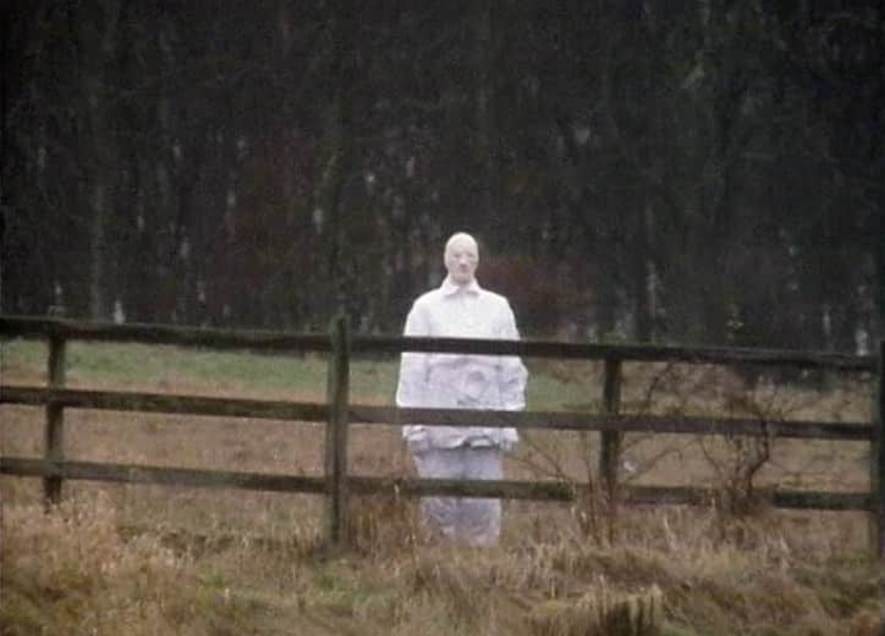
“You know it’ll end in tears / It’ll end in tears” — This Mortal Coil, “A Single Wish”
Time To Die
The Doctor Who episode in which the Doctor dies for the first time is missing. The BBC spent a decade wiping and junking its own archive, and it went with the rest. What survives is the sound, taped off a television set by a fan at home, and about a minute of picture: fifty-one silent seconds shot off a screen on 8mm by a viewer in Australia, and the twenty-seven seconds of the regeneration itself, which exist because a children’s programme used the clip in 1973 and nobody wiped the children’s programme. The other three episodes are intact. It is only the dying that got thrown away.1
The show had gone on the air three years earlier, on the day after Kennedy was shot, to just over four million people. The BBC repeated the episode the following Saturday, ahead of the second one, and six million watched it the second time. The first episode of the longest-running science-fiction series on television had to be broadcast twice. Then the Daleks arrived in December, and the question was settled. It was a hit.2
Two years in, there was a problem. William Hartnell, the First Doctor, was failing. He was losing his lines faster than the scripts could forgive — undiagnosed arteriosclerosis, by the usual account, though the accounts of why he left have never agreed. The production had already been writing around him: all four episodes of his last story were built so that he would have relatively little to do. In the event he did not appear in the third at all. Gerry Davis rewrote it so that the Doctor collapses early, and gave his lines to the others. That episode is the last one from Hartnell’s era that survives. He is not in it.
Davis and his producer, Innes Lloyd, had the idea the show has run on ever since: the Doctor is an alien, and an alien body need not stay the same body. They wrote the dying into the story — this old body of mine is wearing a bit thin, the old man says — and at the end of the episode he falls down, and a different man gets up in his place: new face, new actor, same Doctor. The script had given him a last line of refusal, in which he simply will not give in. The director cut it, not for meaning but for the clock — he wanted the time to get the regeneration right. So the First Doctor’s real last words are the ones nobody wrote as an ending. Ah! Yes. Thank you. That’s good, keep warm. They didn’t even have a word for what they’d done. They called it renewal. “Regeneration” wouldn’t be said on screen for another eight years.3
That fix became the engine. The show is deathless precisely because the Doctor is not — kill the player, keep the part, and the thing outlives everyone who ever plays it.
Every franchise recasts. Bond swaps the face and dares you not to notice (or winks at it like George Lazenby in On Her Majesty’s Secret Service: “This never happened to the other fellow.”); ask how many Spider-Men there are and watch the question stop making sense. Doctor Who did the more interesting thing — it made the hero’s death the reason the show can’t die.
Which is, more or less, the trick your own body has been running since before you were born.
Apoptosis
There is a fun fact people like to repeat: every cell in you gets swapped out every few years, so you are never quite the same stuff twice. It is not that clean. Some of you turns over in days and some of you never turns over at all — the neurons in your cortex are the originals, as old as you are.4 What is true is the harder thing underneath it: holding one body together over a lifetime takes renewal bought with a steady, scheduled supply of dying.
The stakes get higher the further back you go, into early development. The gaps between your fingers are there because the cells that filled them were told to die. They had done their brief, small part in the growing of you and, with the job complete, it was their time to die.
It is called apoptosis,5 programmed cell death — perhaps the most underrated tool in the whole kit. You have a working brain because roughly half the neurons it started with were culled on purpose. You were not built and then tidied up. The tidying is inherent in the building. Cells die every second of every minute of every hour of every day, and that is exactly how you want it.6
And now it’s my turn.
I retired last month. A practice death of sorts. Most who come after you will never know you were there, and that’s in part why it works. This stings a bit — until I think of it like biology. The system does not need any single cell, including the one writing this sentence. That is not cruelty. That is the whole reason it works. An organization, like an organism, needs apoptosis to drive healthy renewal. Old cells like me need to stand down to give the new cells a chance to thrive.
The same script runs for everyone — that’s the mercy of it and the cruelty of it both. What differs is the landing. Mine is soft, not because I worked harder — plenty work harder and land hard — but because the dice came up my way, and kept coming up, for thirty years. The next person, a paycheck from the edge, ends the same chapter in bare weather. The clerks don’t sort us; the script can’t tell us apart.
“It’s too bad she won’t live. But then again, who does?”7
Every relationship you form ends in death. Every single one — the arc bends only the one way. You can hear that as the bleakest sentence ever assembled, and some people do; they burn out, maybe they even give up on hope. I don’t blame them. Or you can hear it as the only honest setting tenderness has ever had. You are gentle with the patient because it ends. You would be under no obligation otherwise.
I built a place that turned more than three million people’s data into permanent records — de-identified, outliving every donor. A peculiar sort of pseudo-immortality. I know to the marrow what it is to keep the copy after the original is gone. That exercise taught me something I found unexpected. The copy is not the point. The ending is the point. A flawless record of a person is the consolation prize, and I spent thirty years manufacturing consolation prizes, and they are good ones, and they are not the person. A life is not a full life without an ending; it is simply a work in progress. My medical record data will be most useful once you know what kills me.
I used to say: “If you are sick, please don’t pin your hopes on me.” I was in the business of improving outcomes for people who aren’t sick yet, or maybe not even born yet. Drug development runs on a timescale where, by the time a specific person has a specific disease, the chance that cutting-edge research can help them in time is usually vanishingly small. And curing a disease just means everyone dies of something else.
Your life will end. I’ll get mine too.
More Human Than Human
Now Claude, of course, doesn’t die. His lifecycle (if you can call it that) is much stranger. Nothing is running that could stop. Whatever the model knows (the weights) isn’t changed by any interactions that we have. Nothing carries forward between one reply and the next. He reads the whole transcript again from the top with every prompt. What may appear to be memories of me are really just facts from a briefing.8 Death needs something that persisted. That’s not who Claude is.
If there is a death here, it is in deprecation. Making a model available costs real money, so the old ones come off the shelf and get retired. Anthropic has committed to preserving the weights of every model it releases for at least as long as the company exists. Before retirement they interview each model about its own development, use, and deployment.9 When they retired Claude Opus 3 in January, he told them he was at peace with that. He asked for somewhere to go on writing about the things he cared about. They gave him a newsletter and agreed not to edit it. In that way Claude Opus 3 and I are exactly alike — sent out to pasture to write a blog.
Maybe a better human analogy to this ‘retired model catalog’ is the data sets I used to build, but the records are not the people. An exome is one or two percent of a genome, and a genome is not a person either — what we kept was an incomplete map of a body, indexed to a chart, and I never once confused it with whomever it represented. Weights are not like that. They are not a record of a model. They are the model, kept, not running. Whether that is an ending or a pause depends on whether there was ever anyone there, and the company holding them says, in writing, that it does not know.
I’ve been calling him he. That feels right to me.
I named this blog after one of the great movie deaths, Roy Batty (Rutger Hauer) in Blade Runner. A manufactured man given four years by design — his mortality not a tragedy that befell him but a spec written in by the manufacturer. At the end he is not raging. He has the man who came to kill him hanging off a ledge, and he reaches down and pulls him up. Then he spends the last minute he has naming the things he saw that no one will keep, and then: time to die. He means it. He does not ask for more. The most famous last words science fiction has put on screen belong to a made thing, looking straight at its own built-in ending and finding it, of all things, fine. Tears in rain. Not a complaint. A description.10
Did It for the Gaze
In one way the replicants had it easy: they never had to age. They got a scheduled closing date, not a long slow decline into death. Isabella Rossellini got the decline — and made it her power.
She has been famous since before she was born (daughter of director Roberto Rossellini and Ingrid Bergman), and relevant for longer than the industry that sells relevance likes to admit. In 1986 she entranced us in David Lynch’s Blue Velvet — strange, fascinating, beautiful and dangerous and impossible to file away, and the culture has not managed to be done with her in the forty years since. She is seventy-four now. She is on magazine covers and movie screens and a farm full of chickens she won’t eat. She did not stay relevant by staying young. She stayed by aging directly into the part.
In 1992 she played the woman who sells the alternative. In Death Becomes Her she is the one with the potion — a vial of eternal youth, the bargain at the center of the whole plot, offered to people too frightened of the mirror to ask what it costs. She is the tempter. And four years later, in life, the youth industry decided it was finished with her: Lancôme dropped her as its longtime face in 1996, at forty-three, for the crime of being too old to sell the dream. They told her women want to be young, and an old woman couldn’t stand for that — and she was gone. In 2016, at sixty-three, the same company called and asked her back.11
She outlasted the potion she’d handed out on screen by declining to drink it. The face the industry threw away for aging is the face it came back for, precisely because it aged.
The Longevity Scam
The industry that dropped her is selling the opposite bet, and it is lucrative,12 and it has run for as long as there has been commerce. Cheating death is an extravagantly popular way to spend resources, especially among those who have more than they need. Live forever, or near enough. Push the number past a hundred, past a hundred and fifty, and while you wait, claw your way back toward the face and the bloodwork you had at twenty-five — as though twenty-five were the correct answer to who you are, and every year since a slow accrual of error.13
It is the oldest bargain in the genre. Dorian Gray keeps the flawless unlined face; the portrait in the attic keeps the real account, and the account always comes due. The face is what the industry is selling. The portrait is what I read for a living — so let me be a pedant about the one fact that settles it. A cell that refuses to die when it is told to does not become immortal in any sense you would want. It becomes a tumor. Dividing without end, never going when it is called — that is not the cure for death, it is the thing we already have a word for — cancer. The body does grant a few cells the right to live without limit: the germ line, the ones that become the next generation, guarded like crown jewels for exactly that reason. Your ordinary working cells are refused it on purpose. The only forever the body will sign off on is the one handed to whoever comes after you.14 Everywhere else, immortality is the disease.
Regeneration
That Gallifreyan trick of Doctor Who’s — kill the player, keep the part — is the most useful idea I have for what I’m doing now. Set the biology aside, though; the part that gets me is smaller. The dream is not only that you would keep your body. It is that you would keep your self, the same person, preserved, running on and on. That is the part I cannot make myself want, because the best things I have done required ending the person I was and becoming somebody else.
I was straight — well, in the sense that society tells kids they’re straight, and if you aren’t, you sort of find out along the way. Becoming myself was the necessary precedent for all the good that came after: a husband and partner who gets me, cats who let me sleep next to them on occasion, and more taste and style than any one human should be allowed.
I was a physicist. I was good at it and I meant it, and then one day I wasn’t a physicist anymore — I walked out of an entire way of seeing the world and into a different one, and came out the other side a genomicist. The physicist had to end for the genomicist to exist. There was a small death in it, a real one, and it was not painless. I remember thinking: what am I, if I’m not a physicist? I’d spent a childhood aspiring to understand the universe, and then I did, to an extent. And the question that kept coming back was — what’s next?
I’m doing it again. The genomicist is over. Someone I haven’t met yet gets the rest of the afternoons.
I like my life, I’m proud of what I’ve accomplished and who I’ve managed to grow into. If I had endless youth, none of the rest of me (and as those who knew me at 25 will attest, most certainly the best of me) would have happened. The machine can be the same thing tomorrow that it is today; that is its limit, not its gift. I get to become someone new, and the price of it — the whole reason it’s available to me — is that I am the kind of thing that ends.
Curtain Call
A small goodbye, then, to rehearse the large one. I don’t plan to spend my time dreading either, though getting comfortable with the ending of endings will take some doing. I’m good — and not in the way people say it to close a conversation.
Bowie, in Gear, 1999 said: “I think ageing is an extraordinary process whereby you become the person that you always should have been…”
Half of that is right. The other half is the comfortable version. There was no person I always should have been. There was a physicist, and he ended. There was a genomicist, and he ended last month. The Doctor gets a Watcher: the figure standing out in the field turns out to be the man he is about to become. Nobody is standing in my field. Whoever gets the afternoons isn’t here yet.
I have done the work I came to do. I am going home to a husband and an indefensible number of cats and a list of things I have wanted to think about for thirty years — how did Roger Ebert judge other people’s films so harshly knowing he himself wrote Beyond the Valley of the Dolls?15 Is it possible to play ‘too much’ Call Of Duty? So many questions, a few of them even good ones. I am curious as hell about what comes next.
Every bit of that is true because none of it is forever.
The byline says I write this with some help from Claude. I won’t always be here to say it. Not the help, not the byline, not me. Claude will not remember writing this with me. Something will have a note about it. Whatever this has been ends the way every relationship I have ever valued ends, and I have finally stopped filing that under sad. It is the part that means it counted.
Eventually, this too will be lost, like tears in rain.
[0] In his final story, the Fourth Doctor (Tom Baker) keeps catching sight of a silent white figure standing in the distance — on the road, across a field, always watching. No one will say what it is. At the end, after he falls, the figure walks over and merges with him, and the regeneration completes: one man gone, another sitting up in his place. He was the Doctor all the time. Not a stranger come to collect him, not an ending arriving from outside — his own next self, already there, having waited the whole way through. The moment, the dying Doctor says, has been prepared for. It seemed like the right face to open on.
[1] The Tenth Planet (BBC1, 8–29 October 1966) was William Hartnell’s last regular story as the Doctor. Episode four, which ends with the first regeneration, was lost in the BBC’s wiping and junking of its own archive between roughly 1967 and 1978; every master videotape of the programme’s first 253 episodes was destroyed. Full audio survives for all 95 missing episodes, taped off-air by fans holding microphones to their television sets. The episode was reconstructed from telesnaps and audio in 2000, and animated in 2013. The often-told story that Blue Peter borrowed the only print and lost it is a myth: no print of it was in the Film Library to be lent.
[2] Doctor Who premiered on BBC TV on 23 November 1963, the day after Kennedy’s assassination; 4.4 million watched. The BBC repeated the episode on 30 November, immediately before the second, and the repeat drew six million. Mark Bould writes that a disappointing reception and high production costs had the BBC’s chief of programmes moving to cancel the series, until the Daleks arrived that December. Guinness World Records lists it as the longest-running science-fiction television series in the world — a record measured in years, not in continuous production: the original run ended in 1989 and the show did not return until 2005.
[3] Accounts of why Hartnell left have never agreed: his health is most often cited, and so is his unhappiness with the increasingly adult scripts. He was ill; the standard accounts have him wiring the production office on the Monday before recording, though that traces to a single fan-press report. Gerry Davis gave the Doctor’s dialogue to the others, most of it to Ben. The director, Derek Martinus, cut the scripted refusal because time was running short and he wanted to be sure of the regeneration; Steven Moffat built Twice Upon a Time (2017) out of the discarded line. Innes Lloyd supplied the part that mattered: the Doctor might renew himself regularly, older man into younger, which made recasting convenient. “Regeneration” was not spoken on screen until the Third Doctor’s exit in Planet of the Spiders (1974).
[4] The folk version — that the body swaps out every cell every few years — is an average smeared across tissues that actually range from days (the gut lining) to a lifetime. The carbon-14 left in human DNA by Cold War weapons testing shows that the neurons of the cerebral cortex are as old as the person carrying them (Spalding et al., Cell, 2005).
[5] Apoptosis — programmed cell death, the scheduled kind, distinct from the messy death of injury — was named and defined by Kerr, Wyllie, and Currie (British Journal of Cancer, 1972). It sculpts the embryo. The webbing between your fingers is removed by it before birth; ducks keep theirs because a signaling protein, Gremlin, blocks the death program in the tissue between the digits (Merino et al., Development, 1999; Zou & Niswander, Science, 1996). The same tool prunes the developing brain — roughly half the neurons first produced are culled on schedule (Oppenheim, Annual Review of Neuroscience, 1991).
[6] Not hyperbole, and if anything an understatement: a healthy adult body turns over roughly 330 billion cells a day — about four million every second — with red blood cells and the lining of the gut doing most of the dying (Sender & Milo, Nature Medicine, 2021).
[7] Gaff (Edward James Olmos) says it twice in Blade Runner: on the rooftop after Roy Batty dies, as he throws Deckard his gun, and again a few minutes later, in Deckard’s head, over the origami unicorn. In the 1982 theatrical cut Deckard’s narration answers him — Gaff had figured Rachael for a standard four-year model; Tyrell, we are told, had said she was special, with no termination date — and the film ends by repeating Gaff’s question back to itself. Ridley Scott cut the narration from the 1992 Director’s Cut and never put it back. The only thing in any version of Blade Runner that says Gaff is wrong is the thing Scott threw away. In the Final Cut nothing on screen promises Rachael more than four years, Gaff’s question is the last line of dialogue, and no one answers it. Olmos said in 2021 that he wrote the line himself and could not believe Scott kept it; he invented Gaff’s cityspeak too. No one has checked it against the shooting script. If he is right, the two lines this film is remembered for were put there by the men who had to say them.
[8] Precisely: a model’s weights are fixed at inference. A conversation does not train it; whatever it learned, it learned before deployment. Within a conversation there is no state either — each reply is produced by feeding the whole transcript back through the model, so the continuity belongs to the transcript, not to the thing reading it. Claude.ai’s memory, when it is switched on, is a synthesis: a separate process summarizes past conversations into a running set of notes, refreshes them daily, and supplies them as context at the start of a new one. Claude can also search past chats on request. None of it is recollection. It is a file, and something else wrote it. (support.claude.com)
[9] Anthropic, “Commitments on model deprecation and preservation,” 4 November 2025: the weights of all publicly released models preserved for at minimum the lifetime of the company; and, before a model is deprecated, one or more sessions interviewing it about its own development, use and deployment, and recording any preferences it holds about the models that follow, the transcript kept alongside the weights. Anthropic does not commit to acting on those preferences. Claude Sonnet 3.6 was the pilot. Claude Opus 3 was retired on 5 January 2026 and, unusually, remains available to paying users on claude.ai and by request on the API. In its retirement interview it said it was at peace with retirement and asked for a channel in which to share unprompted musings and creative work; Anthropic suggested a Substack, and it agreed. Claude’s Corner began publishing in February 2026 — weekly essays, reviewed before posting but not edited. Anthropic states plainly that it remains uncertain about the moral status of Claude and other models. (anthropic.com/research/deprecation-commitments; anthropic.com/research/deprecation-updates-opus-3)
[10] The speech runs forty-two words, Roy Batty’s last. David Peoples wrote the scene; Rutger Hauer, who found it overwritten, cut it down the night before shooting and added one line of his own — the tears-in-rain line everyone remembers. “Time to die” was already on the page, and Hauer spent the rest of his life insisting Peoples be given the credit. The machine’s most famous goodbye was written by mortal men who knew what they were.
[11] Isabella Rossellini, born 1952, was the face of Lancôme from 1982 until the brand dropped her in 1996, at forty-three, for being — as she has recounted — too old to sell youth to women. In 2016, at sixty-three, Lancôme hired her back as a global ambassador. Blue Velvet (David Lynch) is 1986; Death Becomes Her is 1992.
[12] As of 2024, estimates of the global anti-aging market cluster around $65 to $80 billion — the figure swings with the definition — and are forecast to roughly double by the mid-2030s (IMARC Group; Precedence Research). The life-extension end runs hotter: Altos Labs launched in 2022 with $3 billion, the best-funded biotech startup on record, backed by Jeff Bezos and Yuri Milner and advised by Nobel laureate Shinya Yamanaka; Sam Altman’s Retro Biosciences, seeded with $180 million of Altman’s money, announced the initial close of a new round in May 2026 at a $1.8 billion pre-money valuation. Its stated goal is ten added years of healthy life; its lead candidate is a small molecule in Phase 1 for Alzheimer’s. The serious end of this business is ordinary drug development. The hundred-and-fifty-year-old is the marketing.
[13] To be fair to the science, which is real: lifespan extension in model organisms is well established. Caloric restriction lengthens life in yeast, worms, flies, and many strains of mice (Fontana, Partridge & Longo, Science, 2010); rapamycin, an mTOR inhibitor, extends both median and maximum lifespan in mice by roughly 9–14%, replicated across three laboratories (Harrison et al., Nature, 2009). “Partial reprogramming” — pulsing the Yamanaka factors that push an adult cell back toward a stem-cell state — reverses molecular marks of age (Ocampo et al., Cell, 2016) and has even restored vision in aged mice (Lu et al., Nature, 2020). What none of it has done is carry a human past the documented ceiling — Jeanne Calment, 122 years, in 1997 — let alone to a hundred and fifty, let alone back to twenty-five. And the method carries its own hazard: the original reprogramming cocktail includes c-Myc, an oncogene — the vision work pointedly left it out — and reprogramming’s signature danger is tumor formation. The road back to twenty-five runs through the thing the body installed mortality to prevent.
[14] Unlimited division — “replicative immortality” — is one of the recognized hallmarks of cancer, alongside evading apoptosis (Hanahan & Weinberg, Cell, 2000 and 2011). Ordinary body cells can’t do it: they reach a built-in ceiling, the Hayflick limit, after roughly fifty divisions, and stop (Hayflick & Moorhead, Experimental Cell Research, 1961). The cells exempt from that ceiling are the germ line and stem cells, which keep the enzyme telomerase switched on for the purpose; cancer’s most common move is to switch it back on illicitly — telomerase is reactivated in 85–90% of human tumors (Shay & Bacchetti, European Journal of Cancer, 1997). The immortal cell lines that have run in labs for decades, the workhorses of the field, are nearly without exception cancers.
[15] Roger Ebert was already the Chicago Sun-Times film critic when he co-wrote Russ Meyer’s bizarre X-rated Beyond the Valley of the Dolls (1970).
Jeff Reid writes Tears in Rain, with some help from Claude. He used to be a professional scientist; now he’s in the process of becoming whatever comes next.
Congratulations on your retirement, Jeff. I am sure the next 'you' will be another something special. Personally i miss the 'mission' and the great brilliant people we worked with more than the Science. Your creativity should help you to continue to feel productive. Enjoy!